Utilizing proprietary surface technologies, SRT SEC phases are made of the uniform,
hydrophilic, and neutral nanometer thick films chemically bonded on the high purity and enhanced mechanical stability silica.
This proprietary surface technology results in excellent column-to-column reproducibility.
The nature of the chemical bonding and the maximum bonding density of the thin film benefit SRT SEC phases with high stability
and negligible non-specific interactions. Along with the widest pore size selection of 100, 150, 300, 500, 750, 1000 and 2000Å,
SRT SEC packings have highest capacity that enables highest resolution.
"Tough samples" such as hydrophobic proteins like insulin, membrane protein monoclonal antibodies derivatized with polymer branches, e.g. polypeptide, PEG.
For biological separations, nonspecific interactions with the packing materials are the major source for low separation efficiency, such as peak tailing, as well as low recovery. The unique surface chemistry of SRT SEC packings provides 1) uniform, neutral and hydrophilic coating that eliminates the hydrophobic interactions with proteins, and 2) maximum density of bonding that minimizes the electrostatic interactions with proteins. This specially designed coating allows SRT SEC columns to achieve high resolution and high efficiency separations. For example, uracil, as a test compound is measured at efficiency up to 90,000 plates per meter, as shown in Table 1.
Table 1. Column efficiencies (measured using uracil in 0.15 M phosphate buffer, pH 7.0).
SRT SEC-100 (5 µm)
>100,000 plates/meter
SRT SEC-150 (5 µm)
>90,000 plates/meter
SRT SEC-300 (5 µm)
>90,000 plates/meter
SRT SEC-500 (5 µm)
>85,000 plates/meter
SRT SEC-1000 (5 µm)
>90,000 plates/meter
SRT SEC-2000 (5 µm)
>85,000 plates/meter
High Loading Capacity and Resolution
Loading capacity is critical for size exclusion separation and purification.
High Stability of SRT SEC Phases
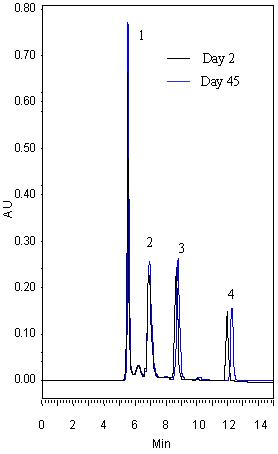
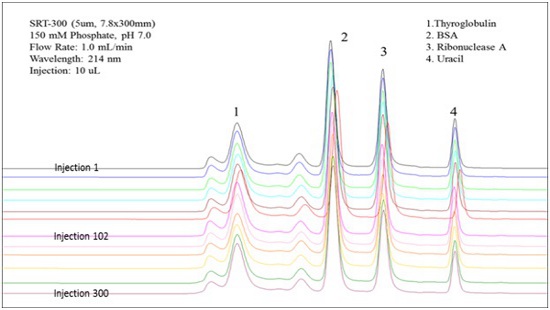
SRT SEC columns have a stationary phase that is densely bonded on the silica surface which greatly hinders the diffusion of any molecules that would attack the bond of silica-stationary phase layer, thus enabling high stability. SRT SEC phases are compatible with most aqueous buffers, such as ammonium acetate, phosphate, trizma and so on. When 150 mM phosphate buffer at pH 7.0 was used as the mobile phase, the average retention time change was within 5% after 100 injections in 45 days. SRT SEC phases can tolerate very high concentration of salts, such as 1.0 M. SRT SEC columns are stable in both organic solvents, such as methanol, ethanol, THF, DMF, DMSO, and so on, and the mixture of water and organic solvents.
Stability test for retention time of proteins and a small molecule
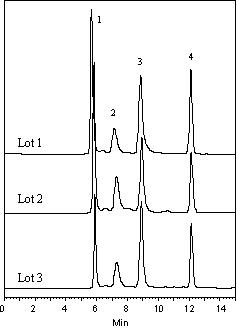
The controlled surface chemistry used to synthesize SRT SEC phases makes the surface coating very reproducible, leading to very consistent columns. Separation variation from batch to batch is within 5% for retention time. Figure below is a separation of the Sepax standard protein mixture by the SRT SEC-150 columns from three different lots. The largest variation retention time for ribonuclease A is less than 2%.
Comparison of the separations by three different batches of SRT SEC-150
The Impact of Pore Structure on Separation, widest selection of pore sizes from 100 Å to 2000 Å
The pore size of the SEC packings plays a critical role in protein separations. The selection of an SRT SEC phase for a particular molecular weight range protein sample is based on the exclusion limit and linear molecular weight range of the SRT packings:
SRT packings
Protein MW exclusion limit
SRT SEC-100
66,000
SRT SEC-150
150,000
SRT SEC-300
1,250,000
SRT SEC-500
5,000,000
SRT SEC-1000
7,500,000
SRT SEC-2000
>10,000,000
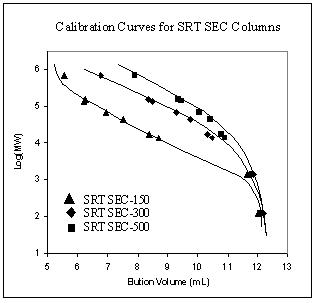
MW Calibration for Protein Separation
For size exclusion chromatography, individual pore size packings determine the range of molecular weight for separation, while the pore volume controls the separation capacity. SRT's six pore size packings cover the separation of a wide range of biological molecules. The protein calibration curves for SRT SEC-150, SRT SEC-300, and SRT SEC-500 are shown in figure below.
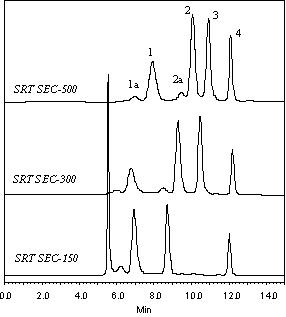
Separation of BSA dimer from BSA protein
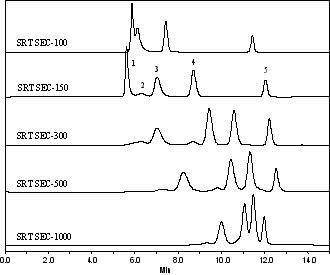
The chromatograms show baseline separation of BSA dimer from BSA for all three SRT SEC-150, SRT SEC-300 and SRT SEC-500 columns. Due to the difference of pore sizes, the retention time for BSA and BSA dimer are different. The smaller the pore size, the shorter retention time for BSA and BSA dimmer. Since the MW of BSA (67K) and BSA dimmer are in the separation range for all those three columns, the resolution (separation factor) for BSA and BSA dimer is slightly varied.
Separation of the aggregates from thyroglobulin
Thyroglobulin is a huge protein (MW 670,000). The commercial sample of thyroglobulin contains the aggregate impurity, possibly dimer or tetramer. SRT SEC-300, SRT SEC-500 and SRT SEC-1000 provide a baseline separation of the aggregates from thyroglobulin, as shown in both chromatograms. Due to the small pore size of SRT SEC-100 and SRT SEC-150, both thyroglobulin and its aggregates are totally excluded, resulting in a sharp peak.
High Protein Recovery and Maintaining Activity
SRT SEC phases are composed of a hydrophilic, neutral thin film that is covalently bonded on the silica surface with the maximum density. Proteins and other biological molecules have negligible nonspecific interactions with such stationary phases. The protein adsorption to the silica surface is suppressed, leading to high recovery and maintaining the activity after the separation. Table below shows the recovery results of BSA and lysozyme, the representatives for acidic and basic proteins, respectively.
Recovery of proteins from SRT SEC columns (measured with a 4.6×300 mm column in 0.15 M phosphate buffer, pH 7.0)
Column
Protein Recovery%
SRT SEC-100
BSA
>95%
Lysozyme
>95%
SRT SEC-150
BSA
>95%
Lysozyme
>95%
SRT SEC-300
BSA
>95%
Lysozyme
>95%
SRT SEC-500
BSA
>95%
Lysozyme
>95%
SRT SEC-1000
BSA
>95%
Lysozyme
>95%
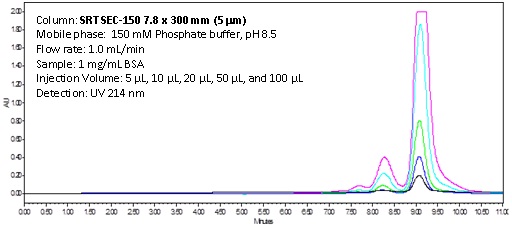
High stability at pH 8.5
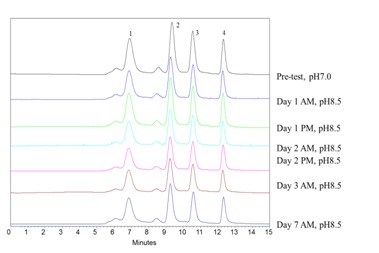
SRT SEC columns are stable over a wide range of pH from 2 to 8.5. In addition, they can even tolerate higher pH, such as pH 8.5-10 for temporary usage. Figure below shows that SRT SEC-300 phase demonstrates negligible change after running 700 column volume of phosphate buffer at pH 8.5.
The temperature tolerance for SRT SEC phases is also excellent. The working temperature can go as high as 80°C.
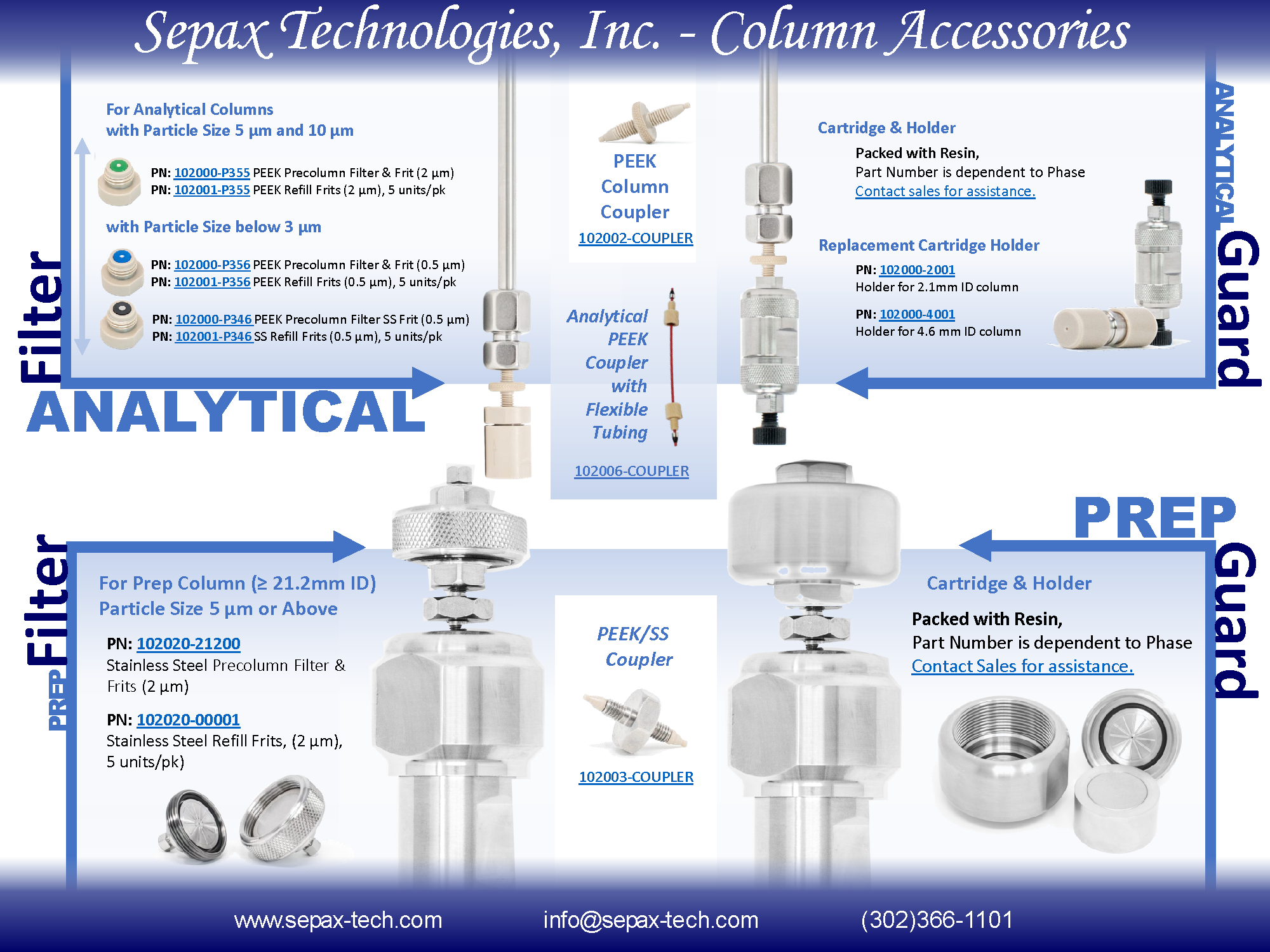
[1] Guard column [2] Column packed with PEEK tubing. [3] Sepax Protein standard for size exclusion chromatography and used for general correlation of elution time vs. protein MW [4] One-piece PEEK coupler, recommended to connect columns in series. [5] PEEK/Stainless Steel coupler, recommended to connect columns of IDs > 7.8 mm in series. [6] Column coupler with 10cm length flexible tubing,10-32 fitting with 1/16 OD PEEK tubing. Recommended to connect analytical columns in series [7] 2 µm PEEK frit for column with particle size 5 µm and 10 µm. [8] Intended for use with column IDs ≥ 21.2 mm [9] For Precolumn Filter (2 µm) 5 units/pk [10] SS Refill Frits for 102020-21200, 5 units/pk
[1] Guard column [2] Column packed with PEEK tubing. [3] Sepax Protein standard for size exclusion chromatography and used for general correlation of elution time vs. protein MW [4] One-piece PEEK coupler, recommended to connect columns in series. [5] PEEK/Stainless Steel coupler, recommended to connect columns of IDs > 7.8 mm in series. [6] Column coupler with 10cm length flexible tubing,10-32 fitting with 1/16 OD PEEK tubing. Recommended to connect analytical columns in series [7] 2 µm PEEK frit for column with particle size 5 µm and 10 µm. [8] Intended for use with column IDs ≥ 21.2 mm [9] For Precolumn Filter (2 µm) 5 units/pk [10] SS Refill Frits for 102020-21200, 5 units/pk
[1] Guard column [2] Column packed with PEEK tubing. [3] Sepax Protein standard for size exclusion chromatography and used for general correlation of elution time vs. protein MW [4] One-piece PEEK coupler, recommended to connect columns in series. [5] PEEK/Stainless Steel coupler, recommended to connect columns of IDs > 7.8 mm in series. [6] Column coupler with 10cm length flexible tubing,10-32 fitting with 1/16 OD PEEK tubing. Recommended to connect analytical columns in series [7] 2 µm PEEK frit for column with particle size 5 µm and 10 µm. [8] Intended for use with column IDs ≥ 21.2 mm [9] For Precolumn Filter (2 µm) 5 units/pk [10] SS Refill Frits for 102020-21200, 5 units/pk
[1] Guard column [2] Column packed with PEEK tubing. [3] Sepax Protein standard for size exclusion chromatography and used for general correlation of elution time vs. protein MW [4] One-piece PEEK coupler, recommended to connect columns in series. [5] PEEK/Stainless Steel coupler, recommended to connect columns of IDs > 7.8 mm in series. [6] Column coupler with 10cm length flexible tubing,10-32 fitting with 1/16 OD PEEK tubing. Recommended to connect analytical columns in series [7] 2 µm PEEK frit for column with particle size 5 µm and 10 µm. [8] Intended for use with column IDs ≥ 21.2 mm [9] For Precolumn Filter (2 µm) 5 units/pk [10] SS Refill Frits for 102020-21200, 5 units/pk
[1] Guard column [2] Sepax Protein standard for size exclusion chromatography and used for general correlation of elution time vs. protein MW [3] One-piece PEEK coupler, recommended to connect columns in series. [4] PEEK/Stainless Steel coupler, recommended to connect columns of IDs > 7.8 mm in series. [5] Column coupler with 10cm length flexible tubing,10-32 fitting with 1/16 OD PEEK tubing. Recommended to connect analytical columns in series [6] 2 µm PEEK frit for column with particle size 5 µm and 10 µm. [7] For Precolumn Filter (2 µm) 5 units/pk
[1] Guard column [2] Column packed with PEEK tubing. [3] Sepax Protein standard for size exclusion chromatography and used for general correlation of elution time vs. protein MW [4] One-piece PEEK coupler, recommended to connect columns in series. [5] PEEK/Stainless Steel coupler, recommended to connect columns of IDs > 7.8 mm in series. [6] Column coupler with 10cm length flexible tubing,10-32 fitting with 1/16 OD PEEK tubing. Recommended to connect analytical columns in series [7] 2 µm PEEK frit for column with particle size 5 µm and 10 µm. [8] Intended for use with column IDs ≥ 21.2 mm [9] For Precolumn Filter (2 µm) 5 units/pk [10] SS Refill Frits for 102020-21200, 5 units/pk
[1] Guard column [2] Column packed with PEEK tubing. [3] Sepax Protein standard for size exclusion chromatography and used for general correlation of elution time vs. protein MW [4] One-piece PEEK coupler, recommended to connect columns in series. [5] PEEK/Stainless Steel coupler, recommended to connect columns of IDs > 7.8 mm in series. [6] Column coupler with 10cm length flexible tubing,10-32 fitting with 1/16 OD PEEK tubing. Recommended to connect analytical columns in series [7] 2 µm PEEK frit for column with particle size 5 µm and 10 µm. [8] Intended for use with column IDs ≥ 21.2 mm [9] For Precolumn Filter (2 µm) 5 units/pk [10] SS Refill Frits for 102020-21200, 5 units/pk